Showing posts with label Nick Clegg. Show all posts

Wednesday, 7 September 2011

Mister Clegg


In the dim and distant past of a couple of months ago, I spent some time following the phone hacking story. I watched the Parliamentary Select Committee ‘grilling’ of the two Murdoch boyz and am looking forward to a repeat performance from Tom Watson, assuming that he is going to be given more flexibility in his delving, assuming he is going to be given the opportunity to really grill James Murdoch about what he knew and what he sanctioned.
Of course, the Murdoch’s have got it all sewn up. There is a police investigation so there are certain questions that they can refuse to answer in case they are accused of prejudicing the aforementioned investigations or enquiries.
I am still a little confused as to the legal status of lying to a select committee. Does it count as perjury? Is not parliament part of the legislative process and therefore lying to such a committee is indeed an act of perjury?

I hope that Tom Watson will eventually be seen as a complete hero for the determination and persistence that he has shown in following his convictions regarding this issue. After all, he is a Capricorn from West Bromwich and I happen to be the offspring of such a combination.

But it is neither Murdoch or Watson or the other Murdoch that I wish to discuss today.
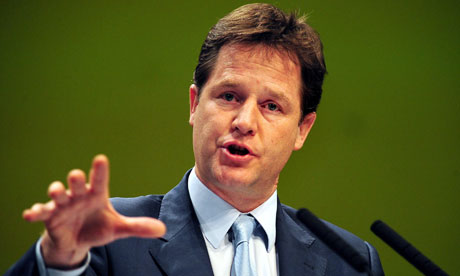
It is Nick Clegg, the leader of the Liberal Democrats, the deputy Prime Minister, the pink Tory, the MP for Sheffield Hallam (for now), ironically born the day before Tom Watson in the same year.

The reason that I mentioned the Murdoch saga was that when parliament was recalled to discuss the phone hacking drama, I spent some time listening to the debate but also paying special attention to Nick Clegg and his reactions. It was fascinating, and I am sure that many a psychoanalyst has studied in greater detail than I to identify the different traits and moods that his body language was emitting.
He had his head down for the majority of the time. His eyes did not rise to the level of any of the speakers for longer than split seconds. There were even times when he raised his eyes to heaven as though he was awaiting some divine intervention to remove him from the excruciating agony of being in partnership with a man who at best had poor judgments in who he employed and socialised with, at worst represented the epitome of corrupt democracy in his relation with the powerful media tycoons. There were even times when Clegg moved his hands towards his face; a classic shielding – but from what was he shielding himself?

Going further back in time, I sat here, on my birthday and listened to the first live debate between the three men hoping to be Prime Minister. Some could easily argue that Clegg was never in a position to be outright leader of the country so he could more or less say anything as he was unlikely to be held accountable.
How short sighted was that Mr Clegg? You should have been a little more optimistic which may have made you a little more circumspect in what you said on that April evening in 2010.

People praised the man for his principles. They admired him for standing his ground. They revelled in his attack on the two main political parties and condoned him for his stance on true democracy. Those of us left of centre could see some real potential in this man’s views. They certainly seemed far left of the alleged socialist party that we had always supported. Tides seemed to be turning and people were beginning to see that a vote for the Liberal Democrats was not merely a wasted vote or a tactical one. There was considerable sense in what he and his party were saying.

The rest, as we know, is history.
I’m not sure what I would have done in his situation. Being serenaded by Ed Balls and Little Willie? Choosing between the two in our monogamous existence of partnership? I’m not sure where I would have gone either.

The Labour Party had screwed up. Clegg knew that there was such general mistrust and disappointment in the country over their mistakes and their reluctance to be radical (in the socialist and progressive sense of the word) that it was almost impossible for him to ‘prop up’ a flailing and failing government. On the other hand, how could he support a party who had such disregard for equality, no matter how much Cameron played the caring conservative card?

He sat proudly on the front bench with his Tory colleagues. The first days in parliament, his body language was far different than the one I witnessed in July of this year. He was cocksure. He was elated. His eyes firmly focused on the opposition benches, riling them, ridiculing them, though of course he would deny such a thing. He was in the most powerful place that any Liberal leader had been for decades. Of course he was swooning on it.

Then there came a huge dose of reality; the student riots, the march for jobs, the unsubtle demotion of Vince Cable for telling it is at should be regarding News International, the health minister’s onslaught, Michael Gove – and so the list goes on.

His own party were weeping. He was caught between the lure of power and the logic of his colleagues. Simon Hughes, a person who has had his fair share of media intrusion, looked ghostly and dejected during that day in July too. He could feel Clegg’s unease but could probably only go so far in his empathy; feeling empathy rather than acting on it. Obviously I am only surmising here for I am not party to Hughes’s thoughts or Clegg’s. It is just an observation, a thought but I felt as though there was a huge amount of sadness rather than resentment within Hughes and many within the Liberal Democrat party.

Since then, what has happened? Nick has been on holiday and perhaps he has had time to reflect on where he is and what he is capable of doing. He must be concerned about his personal political future. There is a distinct possibility that he might not retain his seat in Sheffield. There is huge resentment there for his U-turns and the fact that he is propping up a dysfunctional and radical government. If he makes another U-turn, will that be held against him? Will he ever be forgiven?

Sometimes, there is no greater sacrifice than laying own your own life or your own desires for the greater good, to bastardise a famous politician who didn’t seem to be too damaged by his trip across the floor from one political party to another. If Churchill can turn then surely Clegg can too.
And he has an opportunity, more than one, to make a stand.
He has the power to put a stop to this coalition. He could prevent more mess despite his sell-out on fixed terms and status quo of parliamentary reform.

They sold you a dud Clegg, and you took it.
The lady may not be for turning but you are no lady.

Clegg could choose a range of issues to call a halt to proceedings; subtle privatisation of the NHS, relations between government and the media, economic mismanagement, decline of services to those who require it most, education.

Education, education, education.

It is a popular mantra amongst politicians but when do they ever listen to the people within education, and we are not talking about the bureaucrats at the ‘top’ of local authorities? Education could be the answer to everything, if only these politicians could see further than the end of their political office but then again, how many politicians do you know who have the ability to be holistic? It is not one of their greatest traits.

However, it is education that Clegg has chosen to focus on for his first stance against his colleagues in the cabinet. He has made it very clear that this Free Schools rubbish is very much the domain of the bluer part of the government. He is washing his hands of it all. It was not part of the Liberal Democratic manifesto in 2010, but then again, there were plenty of things that were not in their manifesto that they are now going along with.

Yesterday, Clegg made a speech about the Free School situation. He assures the public, and those within his party, that he has managed a certain amount of compromises from the uncompromisable Gove. He stated that he had received reassurance that any new Free School would be set up in deprived areas. He stated that he had received reassurance that any new Free School was not going to be allowed to work for profit.

Here is the live blog and comments from the Guardian.

And here is the full transcript of Mr. Clegg’s speech.

Too little, too late screamed the NASUWT. Where was Clegg hiding when Gove first pushed his unwanted and ill-thought Education Bill forward as a draft? Why start objecting now when 25 schools are about to open their doors? Well, it is a valid point but let us give him some grace. Let us hear what he has to say and let us see whether this triggers some other radical action from the man.

The NUTters have also stated their concerns, though bizarrely, have linked this to standards. Equality will not be achieved through Free Schools, so states Christine Blower, and there is no evidence that they raise standards. Well Christine, let’s concentrate on the equality issue here for the ‘standards’ come from that.

Yes, Clegg has been slow to act. Yes, it is about equality. Yes, we need to really think carefully about Clegg’s next steps because the Education Bill has not yet been passed.

So looking in greater detail at his speech, are there any underlying issues that could cause him to further reconsider his approval of the Bill?
Here are a few of my comments from the speech.


“And we do the next generation a disservice by cursing them with our low expectations.”
We do an even greater disservice to our next generation by not offering them a proper education that is fit for the 21st century. Hidden in all the major changes within the Bill are expectations for pupils to read 17th century texts that have no bearing on their lives at all. I am all for people studying literature and I am not suggesting that there is no purpose in studying old texts but young people need to feel as though they are involved in their learning. Imposed and illogical texts are not the way to do it. We do a disservice to our next generation by not enabling them to develop the skills and the attitudes to pursue a life of equality and consideration and all manner of other values. Our problem is not just about low expectations. Our problem is that we don’t actually know what our expectations are, and even when we think we know what our expectations are, they are often the wrong ones.

“Labour spent vast sums on schools. And, to be fair to them, some things did get better. Education is clearly an area where money makes a difference.”
Lots and lots and lots of money but no holistic view. Spending money on standards in literacy at the expense of other equally important aspects of living and learning that are going to be so vital for our next generation. Yes, the Labour Party poured millions into the system but how much did all of that affect the needy pupil in the middle of a downtrodden housing estate in a former industrial city? There was ineffectual coordination, there was no overarching theory behind the influx of money other than to raise standards, and there was complete conflict between some socially enterprising (or social engineering policies) and the standards agenda. Of course the Teenage Pregnancy policy did not work. It did not work because there was no legislation to enable those of us who had something to offer schools to actually get in there and make a difference because it was all about standards and only the enlightened few could see the connection between the two.

“Ours is now one of the most unequal school systems in the world. In the UK your background has more of an impact on how well you do at school than in nearly any other developed country.”
Earlier in the speech, Clegg stated that “we allow ourselves to believe some basic assumptions as if they are facts of life” and therefore there is nothing that we can do about them. There are good schools and there are bad schools. Fact. Clegg says that we should not take this as fact. We should do something about it.
So, if our school system is the most unequal in the world, what precisely is this Bill doing to further inequality? Is it all down to the system of schooling or are there other contributing factors like housing and health and support for young families who haven’t got a clue how to cope?
Free schools are NOT the answer, not even if they are established in areas of deprivation. Unless, of course, the schools are free from ALL constraints and can adopt progressive policies of embracing creativity and individuality, of trying to transform lives through a holistic view that incorporates social, moral, spiritual and personal education AS WELL AS concentrating on the basic necessities of literacy and numeracy. This is the ONLY thing that is going to make a difference, together with an all out attack on private education but that is another issue.

“And, when the best schools are concentrated in some communities but not others, poorer families get the raw deal.”
Yes they do. FACT. And what precisely is the likes of Toby Young’s school going to do to solve this sort of problem? Clegg continues to say that any new Free School is going to be set up in deprived areas but what is the point unless, as I say, there is real autonomy for school leaders to follow their vision and offer something completely radical in comparison with what is on offer through the straitjacket currently imposed on our schools, that has been in force for so long that our future leaders are completely and utterly indoctrinated into one way of thinking about education.

“We know that there are a host of tried-and-tested methods for raising attainment. Investing in teachers' training and professional development.
Smaller class sizes. More pastoral support, outside the classroom. Or more intensive, individual tuition.”
No we haven’t! We have NOT tried everything and when interventions such as pastoral support have been established, it is always the first to be cut, and it has been full of complicated red tape. Ask any manager who has tried to develop a role for a learning mentor, for instance. And when has any school had the time and resources to truly look at individual learning, which incidentally Mr. Clegg is quite different to individual learning.

“The same report [from the Sutton Trust] found that when children are older, they benefit from sitting down with teachers to plan and monitor their own progress. They do better if they are given specific, personalised feedback.”
Yes, and once more, when have schools been given the opportunity to involve pupils in planning their learning rather than have it imposed upon them in recent years, in recent decades even? And what is the coalition doing to enable this successful innovation to happen in EVERY school? Hell, you’ve even got the evidence that it works, together with engaging pupils in after school activities.

“Over time, schools themselves will become responsible for the budgets for excluded pupils. They will be expected to commission the alternative education they receive.”
How much time, I wonder? It is indeed good that there is someone to be held accountable for the education of the excluded. Having witnessed an imposed mass exodus from not one but several schools who have become academies in one local authority, I am delighted to hear of such possibilities, but we have already lost a few thousand disaffected young people. Action is needed NOW.

“And we're offering all schools the chance to take on Academy status, either individually or as part of a chain. Where they have full control over their curriculums, staffing and budgets.”
I know this is a naive question but why does it need a school to take on Academy status to get full freedom? Why do you have to be an academy to have “full control” over all the issues that Clegg mentions? Surely this should be an entitlement for every school manager, whereby THEY choose what support they receive from the local authority and not have it imposed upon them as a slapped wrist. Perhaps, if there had been more liberty in the past, with accountability of course, then there would be no need for academies and free schools and all other initiatives that veil the fact that schools are stymied and therefore the pupils within in it are not free to learn properly.

“Sarah Teather is bringing forward a radical set of reforms which will ensure local councils can help knock heads together to get a better deal for disabled and disadvantaged children.”
Unfortunate language here! Knocking heads can cause all manner of disabilities. And is Nick surreptitiously saying that there is an intention to knock ‘heads’ i.e. head teachers into doing something that is detrimental to the needs of the school and the individual pupils within it, disabled, disaffected or not.

“Let me be clear what I want to see from free schools. I want them to be available to the whole community - open to all children and not just the privileged few. I want them to be part of a school system that releases opportunity, rather than entrenching it. They must not be the preserve of the privileged few - creaming off the best pupils while leaving the rest to fend for themselves. Causing problems for and draining resources from other nearby schools. So let me give you my assurance: I would never tolerate that.”
But Nick, that is precisely what you have tolerated. Quid Pro Quo, Carpe Deum, Ergo Propter Hoc – yes, I have no idea about Latin either!
Can you not see that this is precisely what is happening right now. There’s plenty of mention of oversubscription to Young’s little innovative school but how much research has been done on the impact to schools within the area where the frilly little middle classes push off to get what they deserve. What is going to happen to other schools? I know Toby Young would argue that if they were offering what they should have been offering then there would be no need for his popular new school but it is not as simple as that.

“That's why I am pleased that half of the first wave will be in deprived areas. And the vast majority in areas where they desperately need school places.”
Yes, and I wonder how many of those first half of schools set up in deprived areas are actually faith schools rather than schools that are available for all to attend.

“ We are inching towards inserting the profit motive into our school system. Again, let me reassure you: yes to greater diversity; yes to more choice for parents; But no to running schools for profit, not in our state-funded education sector.”
Well, that’s good news. But note the language. No profit in state-funded education. I wonder what will happen when these free schools realise that they can actually make some money and start charging parents for their services. I wonder how quickly they will be able to convert away from state funding. I know that is highly unlikely, but I am reticent to believe that Clegg has this one won. Gove is ruthless, and I am sure that he will find some way of enabling the Free Schools to retain any money that they manage to create for themselves. There will be clauses. I just hope that other schools within the state system that are innovative enough to engage with local and national businesses will be afforded the same opportunities for retaining well-earned monies or carefully agreed sponsorship.

He then continues to discuss the role of parents and how it is important to have a working relationship between parents and teachers as teachers cannot be accountable for all ills in the child.
“Because a teacher can't make sure that children take time at home to get a proper breakfast that sees them through until lunch. They can listen to a child read at school - but they can't do an extra fifteen minutes at home in the evening. A teacher can't turn the TV off when it's time for homework. Or make sure children get to bed on time so they don't come to school tired. Teachers tell me what a huge difference these little things can make. They also know that they can't do them. But they know that parents can.”
Mr. Clegg, please can I inform you that as a teacher, I was not allowed to hear my children read as much as I wanted because my head teacher insisted that it wasn’t my job. I had a literacy hour to stick to and a numeracy nearly hour to religiously and laboriously undertake. Some parents cannot do this, which is why I decided to ignore my stupid head teacher and actually listen to my children read as often as I could, which meant that I made a choice not to eat in the middle of the day – just listen to Biff and bloody Chip. Of course parents make a difference. But here is something that hasn’t been considered. How about not having homework? How about enabling young people of all ages to relax occasionally? How about preventing them from being put off their own learning? How about thinking about something more innovative than spellings and phonics for homework? How much ore might that engage parents in their childrens’ learning, if the ideas were coming from the children themselves?
Just a thought.

I am now going to have to finish because I have gone on and on and on, and for that I apologise but I am passionate about this.

This speech, whilst in parts impressive, strike me as the voice from a puppet, which is mildly ironic considering Gove’s physical attributes (!) are often compared to a ventriloquist’s dummy. Well, the roles have turned. Clegg, he is pulling your strings man! He will give you your little concessions because his hold on power to some extent depends on being a little bit nice to you. You can have your non-profit stuff and your schools in deprived areas (as long as they play the game) but ultimately this Education Bill is full of rot.
Clegg has to really think about whether he can cope with the appeasement offered to him on this and other issues. Shirley Williams has been put in her place and been told that her views are not that of the Liberal Democrats supporting the Health Bill. Was this the right thing to do? Can Clegg really allow all the issues that he raised in this speech to go unnoticed and untackled once more?


Time to think long and hard Clegg. Time to get that metaphorical coffin in your mind, for the sake of so many.

Sunday, 9 May 2010

Electoral Reform

I’m foncused! I’m not sure what I want any more.
The country seems all topsy turvy at the moment which, in a way, is rather stimulating and exciting but at the same time it is unsettling, unnerving and full of trepidation.

My ideal politics and my perfect socially just scenarios were not available in this election. There was no manifesto that matched with my expectations for society but then again, there probably hasn’t been for many a year. There always has to be a compromise. There always has to be a ‘near match’. That is what the electorate have to do when they go into the polling booth and place their ‘x’ in the appropriate or inappropriate box. They tend to vote for the party that most closely matches their views, or sadly, matches the views that have been dripped into them by the Murdoch and Barclay papers.

There are very few people in this world who agree totally with every piece of legislation and every suggestion from the party that they vote for. In 1997, there were fundamental sections within the Labour Party proposals that I totally disagreed with but on the whole, the manifesto (which I did actually read) was in line with what I wanted. And of course, like many people, I had this overwhelming feeling of hope. I, like many people, thought that the first term of a Labour government would tread wearily but once a second mandate had been achieved, they would drive full throttle into the sort of social change that was expected of a Labour government.

There’s little point in reiterating the disappointment that has since ensued. People with far greater writing ability than me have commented over the last decade on this. It is a fact of history and it is time to move on.

What we have now is an absolute that our electoral system is laughable.
We have a situation, once more, where the majority of the population has voted against the party with the greatest amount of Commons seats, and that is without the additional 30, 40 or 50% of people who did not vote in their constituency. That, in itself, is not new. Even in 1997, when Labour won 43% of the popular vote, 31% voted Tory and 17% voted Liberal – and let us not forget this!

We have the paradox of a Liberal Democrat party who have fared far worse than some had predicted yet have more power in their hands for doing so.
It is time for Nick Clegg to make some fundamental decisions and stick to his principles on the reforms to the system that is so vitally required.

There is a hypocrisy from Labour that I find quite abhorrent. Whilst they were commanding huge majorities in the House of Commons, like the Tories before them, they did not want to meddle with this so-called democracy by offering proportional representation or even the watered down version of single transferable vote. It did not suit their needs. It would not keep them in power and they would have to consider the needs of the smaller parties with their views and their requirements.
To start banging on about PR now is painfully opportunist when they have had thirteen years in power to make the sort of amendments that the electorate seem to be demanding.

However, as I said before, that is history and whilst I would be the first to advocate the study of the subject (though not in the way that Michael Gove is suggesting), we have to move on. We can use the information from history to inform us of why there is a moral duty for all parties to look at the bleeding statistics and see how very wrong the first past the post system is.
We can look at the present to see how very wrong the system is. The current situation is hardly an advert for FPTP and strong government.

Whilst it is demonstrating something entirely different, it is an interesting analogy to look at the two electoral maps that the BBC used the other night. The first map showed an almost entirety of blue in England if you looked at geographical distribution. When it was transformed into the hexagonal evenness of equal size per constituency, it showed completely different colour coverage.
This would be even more colourful under PR. People need to look at the stark picture in front of them.

One of the key aspects of democracy for me is that an election should not be about a single issue. Another paradox from this election!
This time it really is about one issue. We need change. We need reform. In order to deal with the other important issues, this is the single issue that has to be altered. If real democracy is going to be the winner, there has to be a system for proper debate about the economy, about education, about society – big or small. The problem with strong government as advocates of FPTP continually bang on about is that on some occasions the largest party are invincible, which means that they can almost work in an autocracy. That’s what happened with Thatcher and that is what happened with Blair. Whatever the other side was opposing, there was an utter futility in even opening your mouth. Laws were going to be passed irrespective of proper debate. Maybe that is why Tony felt he had the right to drag us into an illegal war with all the hundreds and thousands of fatalities therewith.
That sort of absolutism cannot be good for the country; it cannot be good for debate and cannot be good for democracy.

I am now, having been a Labour party follower all of my life, thinking that I don’t want to “belong” any longer. I no longer “belong” anywhere other than holding a fundamental belief in the need for a more equal society. I want to get the Tories, Labour (notice I have deliberately dropped the Nu throughout this blog, pressing the point of hope!), the Liberals and anyone else who wants to join to debate around a table to talk about the issue, without the need for whips or media telling them what to think. Oh and it would be rather good to get some specialists there too. This is what a democracy should look like.

Take education for instance. There is sadly whole party consensus on testing, though I think branches of each party could have their supporters for progressive education. Only the Green Party had a statement in their manifesto about scrapping the tests. However, Scotland and Wales have opted for a more progressive form of assessment. Therefore, the round table should include all parties, experts from a range of educational establishments and not just the Institute of Education with additional educationalists from our Celtic siblings who can come and explain how and why it works. The same could be done for health, crime, the works.
An all party discussion on economics would mean that there would be strength in numbers, excuse the pun. Consensus or certainly majority could be agreed and with expert consultation, action could take place with all knowing they had had their say. Simple really.

Liberty, equality and fraternity are the new black; no need for red or blue or yellow or rainbows.

Politics is no different from anything else in society. Times are a-changing. The expected way of things is not now appropriate. Anachronistic systems are meaningless. Change is coming. 2012.

So where are we now on this cold Sunday morning at the start of May?
Essentially, we are reliant on a group of men leading a singular man on making a decision about how far he can be placated.
Maybe Clegg should do what the rest of us do each time we enter into the ballot booth. We consider, we think, we rationalise and hopefully, we go and vote for the party that we instinctually believe will bring the majority of what we believe in to fruition, even if there are slight compromises along the way. We can argue against those cases later but we cannot argue if we are not given the proper mandate or systems to enable us to do so.

I, like many, am now putting my faith in the resilience and determination of one man to stand resolutely for what he believes in. Any form of compromise on this vital issue will be nothing less than fatal.
If he chooses to compromise on Cameron’s promise for a referendum, he would be behaving hopelessly naively. Unless he gets a written contract from Cameron stating an absolute guarantee that there would not be another general election before electoral reform, referendum and implementation, he should not make any compromises at all. If he wants a further reminder, he should pick up the Observer today and see what William Hague has in line for foreign policy on Europe. It is an alien planet journey away from what the majority of Liberal Democrats and the hidden socialists believe is best for this country. If he still is unsure of whether he wants to get into bed with Cameron and crew, maybe he should really look at the mansion tax and why he wanted it there in the first place. The Tories will always want to protect the wealth of the few. That is a fact and it is a realm away from the type of democratic justice and equality that the Liberal Party has always stood for.
If he wants further support, he should look back in history to the Whigs and their commitment to the poor and impoverished of the land, and they were somewhat more purple than orange in those days. They were the elite with a conscience.

And if he is still undecided, he should just have a little chat with Michael Gove and George Osborne to see what he has in common with them other than a privileged and, in my opinion, deeply flawed education.

There are commentators throughout the land, professional and bloggers, who are making their comments. I profess to no great insight or thoughts. I may even be borrowing the thoughts of other unbeknown but I do feel that there is a real sense of hope. If Clegg is stupid enough to play along with the ambitions of NewCons, then I will be disappointed but will hold high hopes for an election in 2012 at the latest, when the Tory government has come forward in its true colours and pissed the nation off once more.

As for the Labour party – well, we shall see. Getting it back to the views of the mass of support within would be a good start. Maybe as disaffected followers, we should join the party to guide and direct the type of change that we want. But then again, maybe the time for party allegiance is over. Maybe, this is the time to consider themes and issues before towing a party line.
Gordon has to go. We do not want the Tories throwing the comment about an unelected Prime Minister once more, so this has got to be carefully managed.

If Clegg decides he cannot work with Cameron, then he should walk towards Millbank and have a chat with people there but one condition is going have to be the carefully placed comment from Clegg that he could not work with Gordon Brown. There has to be an immediate change or a promise of change from within Labour.
My suggestion has been echoed by many that Gordon should stay in charge for the next four to six months, remembering that much of this will be summer recess.
He should offer a summer referendum on PR with the view to their being a new election either in the autumn if that is feasible or early in 2011. In the meantime, he should remain where he is until a new leader of the party is elected democratically through conference. At that point, he should pack his bags and go, hopefully having done something successful and therefore prevented him from permanently carrying the label of the most useless Prime Minister ever, which is a little unfair when you consider all the Tory nightmares we have had over the years.

It makes you think also about fixed terms and the time between electing an American President and his (or her eventually) inauguration. Nobody questions the time between November and January as far as the markets are concerned. Perhaps we should be doing the same. We wouldn’t be in the position of trying to rush agreement through to satisfy the markets if there was a predetermined process whereby the departing PM remained in Downing Street for a month regardless of whether he lost the election or not. Perhaps this is not ideal but it is worth consideration.

So the foncused remains confused but probably not as much as she thought.
There’s still ideals, there’s still vision, there’s still values that hold as true today as they did last week. There is still a need for hope and a determination for change.

I, like others, sit and wait.

Tuesday, 20 April 2010

Crossing the Channels

Well how bizarre is this!

Following on from yesterday’s report, I am currently sitting in the Club Lounge of the P&O Ferry Pride of Calais. I have not turned into a snob who prefers to travel in luxurious settings. The fact was that if I paid an extra £10 for this, I was guaranteed a full refund should there be any complications with the travel. As the French rail drivers were still deciding whether they were going to operate, or cooperate, it seemed a decent investment.

Meanwhile, I am sitting at a desk, sipping complementary fresh orange juice and eating complementary biscuits and looking at complementary toblerones. My lap top is plugged in and I have just been skyping my friend in Australia to complete a conversation that we started earlier today. Had I had my headphones with me I could have spoken to her too and shown her the view of the approaching French coast.

I am fascinated by technology. I don’t necessarily have a burning desire to know how it all works. I am merely grateful for the advances that means keeping in touch with important people is relatively easy.

When my friend first arrived in the UK from Australia in 1990, I don’t think any of my particular group of peers possessed a mobile phone. My friend J was the first one to get one and that was probably in the middle of the 90s. To think that I can now phone S in Australia via Skype at any time of the day totally free of charge with a full video call is simply astounding. If the greedy companies could get themselves sorted out to ensure that there is not this huge cost between the UK and the continent, I could continue talking to her for no money either. Surely, the time has come for us all to be able to access free internet at any point. I’m happy to pay for my dongle, which I bought a few months ago. It really ought to be useable as I transfer from one side of the Channel to the other.

Dongles, laptops, mobile phones, iPods, cameras, camcorders, satnavs – even taking a day trip or a half day trip across the Channel is full of equipment and chargers. That is one slight draw back but it is worth it. I can amuse myself for the next hour and not get agitated that I am in the middle of the ocean. I can see France approaching although it seems to have disappeared in the mist at present and I can take photos with my newly charged camera. I’m almost regretting the fact that I left the camcorder at home.

The mobile phone is an incredible resource and a wonderful invention. I would not be without mine for anything. I don’t really mind about what type it is though I do love the accessibility to emails and so forth as well as my photos and the information applications. I quite like the games too when I want to lose a few moments to insignificant activity.

I lost my first mobile phone in a service station in Devon. It was a great wad of a thing; cumbersome, black and you had to extend the antennae out to receive or make calls. The phone that I had before the iPhone was so small I constantly lost it in the depths of my bag. Yet for all the faults of always been accessible, they are so much a part of our lives now that you can hardly begin to imagine life without one. It wasn’t so long ago that people didn’t have landlines in homes. An amazing journey has taken place to where we are now.

So, I am waiting for a phone call from my sister to say that she has arrived in Calais. Without this technology, it would be far more difficult to rendezvous. Even if I get lost driving round Calais alone for the first time, I can simply phone her and keep in touch. Also, the Satnav is already set to ensure that I meet up without too many problems.

And yet for all the technological advancements, there are so many ways that our society is still resolutely in the dark ages of pre-mobile phone existence.

Spiritually we are pretty bereft and the revolution has yet to take place. Emotionally, there is no cohesion in truth apart from pockets here and there. As a society we are well and truly stuck in the Thatcherism of me, myself and I. That is going to take generations to overturn.

However, having read another blog this morning, with accompanying hyperlinks for me to view, I was filled with a sense of hope.
This is quite amazing considering some of what was written referred to the hopelessness of our hopes in 1997. One newspaper columnist stated that she thought she had been voting Labour in 1997 but it turned out that she had mistakenly voted Tory, not because she had ticked the wrong box but the “right box” had not even stopped at a shade of purple. It had gone all the way to True Blue.

The ceaseless list of New Labour policies that were adopted to placate the roaming voters and Middle England is quite astounding when you see it written down in black and white. Even the spending on education and health can be drawn to question when you look at it in the right context. Major’s government was hardly social democratic and yet even they didn’t go as far as certain Labour policies like student tuition fees to name but one that particular raises my hackles.

Yet, we are in a time of hope as one should always try to be immediately prior to an election. As the 6th May approaches, I may change my mind and become as despondent as I was on that infamous night of 9th April 1992 when all my hopes vanished in a haze of apoplexy.

The hope, for me, does not lie in the election of one party. Rather it lies in the election of no party. The vision and the social democracy that I believe in and value could happen. It would mean people disregarding their old, familiar ways and their set assumptions around party loyalty. These politicians, following on from the expenses fiasco, would have to do some more rethinking, and people would have to work together.

Let’s face facts, I, like other people who feel disenfranchised by this government have had to do some serious rethinking. As a lifelong supporter of the Labour Party, as someone who genuinely feels committed to social equality and the ending of all injustice and prejudice, I have had to rethink.
As it happens, this is pretty easy for me to do. I live in a Tory stronghold, or should I say stranglehold. There is never likely to be another colour of MP in this constituency even if proportional representation was in place.
However, if I was in a different type of constituency, I would have to really consider how I voted.

I cannot vote for a party who does not seem to believe in the things that I hold dear. Admittedly, my ideology may have more in common with Dennis Skinner than Simon Hughes but the policies and manifestos of these two parties veer me towards the yellow rather than the red.
I don’t think I can possibly explain in this short blog how much that pains me to say. It is actually heartbreaking. By even considering such a move, I feel as though I am betraying my truest love, my father and mother, my entire belief system. However, it is because I have a belief system and values that I have to say this.

I cannot vote Labour because to do so would give them the mandate to continue in this shoddy vein.
I remember having an argument with people in 1987 and again in 1992 about whether Labour should shift ever more central just to get elected. I vehemently refused such an idea. I was accused of being an idealist. Even my cousin, who has since rescinded his Red Card, said that there had to be some shift towards the centre in order for “us” to be elected.

Only at what cost? The cost of everything that you believe in? Free education for all who want it? Free health services where the rich or even the middle classes don’t have to jump the queue by paying a few bob or two? A fair and valued judicial system? A fair and honest approach to government that berids us of the second unelected chamber and the anachronism of a constitutional monarchy? An economy run for the good of the people rather than the good of the few? Brave decisions? Appeasement? Integrity?
And I haven’t even started on the war.

We sold out. Let’s face the facts. We sold out to the highest bidder for the sheer hopefulness of power and the final stampede against Thatcher, even though she had long since gone.
We sold out because it was apparently the only way to get elected and those of us who agreed, albeit subconsciously, to this trade off were anticipating a way back to socialism, at the very least with the second term.

We remain disappointed.

So why the hope?

Well, with Clegg doing so well last Thursday, there is a strong possibility that the Liberal Democrats are going to get a fair share of the vote. With the first past the post system that we currently have, even if they have the majority of people voting for them, they will not get elected into government unless something utterly sensational happens. However, the number of MPs that do get returned to parliament of the yellow variety could dramatically increase.

The projected hung parliament has taken on a completely different scene all of a sudden.
Prior to this major swing, either the Tories could have been reliant on UKIP and even Nick Griffin should he get elected, or Labour would have been in the hands of all sorts of Celtic arrangements with Alex Salmond and his Plaid Cymru counterpart.

With a workable number of Liberal Democrat MPs the power of Clegg and his party increases dramatically. Labour, if they want Liberal support will not be able to stop merely at promising electoral reform. They will have to fully consider Cable’s economic stability ideas. They will have to consider the costings and the philosophy behind the very sensible education package that is currently on offer from the Lib Dems. They will have to look again at the tax system, ensuring that those top 1%ers get taxed properly and fairly for the good of all.

Not only that, but those who hold power within the Labour Party are going to have to listen to the left. In order to secure their support, they are going to have to listen to their views and ideas. They are going to have to reconsider some of their policies and potentially move in a different direction.

This is no longer a two party state, we hope. This is no longer about a tiny minority of MPs holding the balance of power. This is something else entirely.
But what excites me most is the idea that people are going to have to look at policies properly without having to hide behind the party lines. There is a real hope for democracy being the real winner here.

I’m not sure what this has to do with mobile phones and communication, other than the fact that writing my thoughts down like this has eased the considerable stress of getting from Dover to Calais.
But of course, it has everything to do with communications and embracing technology and new ideas and change.
It is all about crossing the channels. Even a phobic like me has to do it at some point in their life.

Maintenant, le soliel est dans la ciel bleu et j’arrive en France a ce moment.
Time to go.

A bientot.